How an Uzbekistan auto parts retailer manages about 10,000 monthly requests with AI
Lynx AI connected customer intake, AI product matching, manager operations and installment control into one measurable workflow for an automotive parts business.
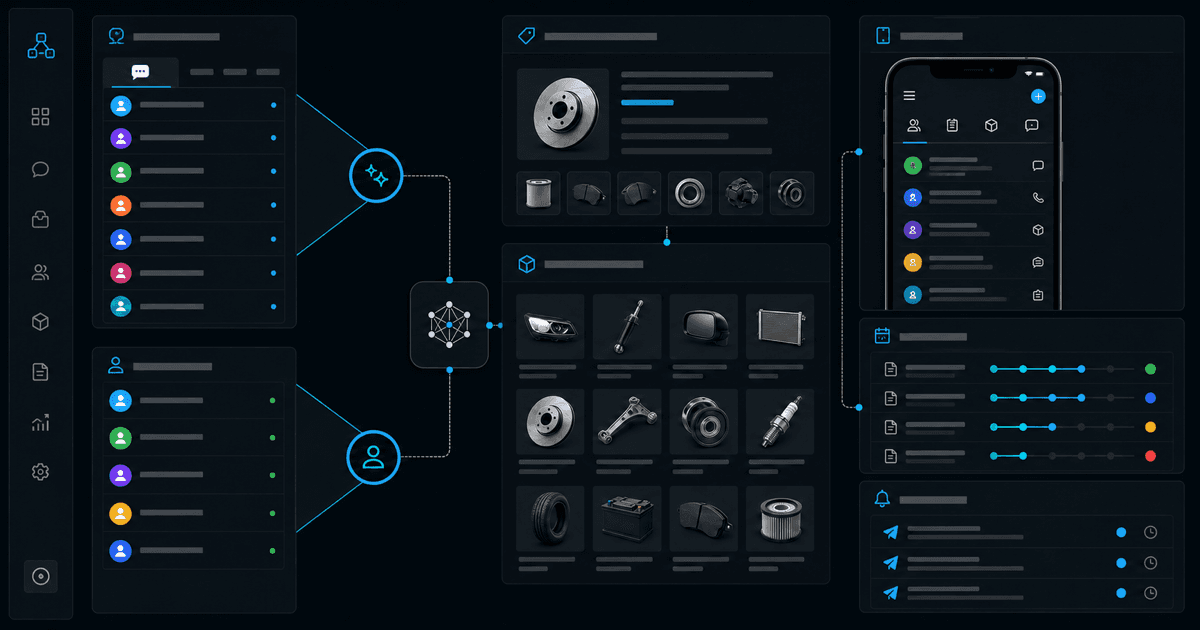
- ≈10,000
- monthly inbound requests
- 2 channels
- Instagram and Telegram
- 2 funnels
- AI and managers
- 1 workflow
- inquiry, sale and payment
How a request moves
- 01
A customer message arrives from Instagram or Telegram
- 02
AI detects the intent and helps match the required product
- 03
Straightforward requests stay in the AI funnel
- 04
Sales-ready requests reach a manager with full context
- 05
The manager works in a mini app and receives notifications
- 06
Payment or installment status remains in the same workflow
- 07
A missed payment triggers an automated reminder
What happened before the unified workflow
The company received a large stream of requests through Instagram and Telegram, but could not see it as one funnel. Messaging, product matching, manager handoff and later payment follow-up lived in separate operational steps.
Leadership could not quickly answer how many requests actually arrived, which ones AI handled, which ones moved to managers, where a sale stopped or who owned the next action.
- Fragmented Instagram and Telegram intake
- No single status and owner for every request
- Limited visibility into AI and manager funnels
- Manual control of installments and missed payments
How Lynx AI connected customer service and sales
An AI agent automated the first line of customer service. It receives each request, understands the need and uses a product parser to help match an automotive part against the company catalog and available business data.
The architecture separates two jobs. The AI funnel handles and qualifies inbound volume, while the manager funnel owns conversations that require human advice, clarification, approval or closing.
- One intake layer across two messaging channels
- AI intent understanding and product matching
- Manager handoff with the collected context
- Separate analytics for AI and human funnels
Manager mini app and operational control
Managers receive prepared requests in a dedicated mini app. Each record keeps the source, conversation context, selected product, current status and next action. Notifications surface new and delayed requests.
This gives leadership operational visibility into workload, funnel movement, stage conversion and manager activity. The case does not claim an unverified conversion uplift; the defensible outcome is that conversion became measurable and manageable.
- Request queue and assigned manager
- Statuses and next actions in one record
- Notifications for new and delayed requests
- Conversion visibility by manager and funnel stage
Installment control and automated reminders
The workflow continues after the sale. It tracks installment schedules and payment status, so managers do not need to assemble a manual list of customers to contact.
When a scheduled payment does not arrive, the system triggers an automated reminder. Complex exceptions stay visible to the responsible manager, keeping automation connected to the real financial process.
- Active installment statuses
- Scheduled payment date control
- Automated reminders for missed payments
- Exception routing to the responsible employee
Why the pattern extends beyond automotive parts
The reusable asset is not a specific catalog. It is the operating pattern: high inbound volume, product or service matching, qualification, human handoff, sales control and post-sale payment follow-up.
The same architecture can be adapted for e-commerce, distribution, building materials, electronics, furniture, healthcare services and other businesses where Instagram and Telegram are active sales channels.
Implementation questions
Is this a real implementation or a demo scenario?
It is a real Lynx AI implementation. The client name is withheld, while the industry, workflow and deployed functions are described without substituting a fictional brand.
Why is the request volume approximate?
Volume varies by season, and the client did not provide a public audit of an exact monthly average. We therefore state “about 10,000” instead of presenting false precision.
Does AI remove managers from the process?
No. AI automates first-line service, matching and qualification. Managers handle conversations that need advice, negotiation or a human close.
Can the workflow use another catalog or CRM?
Yes. Product data, funnel rules, manager roles, notifications and payment statuses are configured around the company’s actual systems and processes.
Want to build a similarly measurable funnel?
Show us the current path from first message to payment. Lynx AI will map an AI funnel, manager handoff, analytics and follow-up reminder architecture for your business.
Discuss a similar projectSolutions used in the architecture
AI agents for sales, support and calls
AI agents that respond to customers, qualify leads, handle calls and sync data to your CRM.
Open solution →Telegram chatbot for business in Uzbekistan
Automate sales and support in Telegram with CRM integration.
Open solution →Instagram chatbot for business in Uzbekistan
Auto-replies in Direct, lead qualification and booking calls.
Open solution →AI business process automation
Automate requests, reports and operations with AI workflows.
Open solution →Related resources
Messaging AI
Telegram bot for business and Instagram Direct bot in Uzbekistan
A practical guide to Telegram and Instagram AI bots for sales: Direct conversations, lead capture, qualification, handoff and CRM sync.
Open article →Automation
Business process automation in Uzbekistan: where AI creates fast value
A practical look at where AI automation removes the most manual work first: intake, CRM sync, documents, task routing and system-to-system workflows.
Open article →